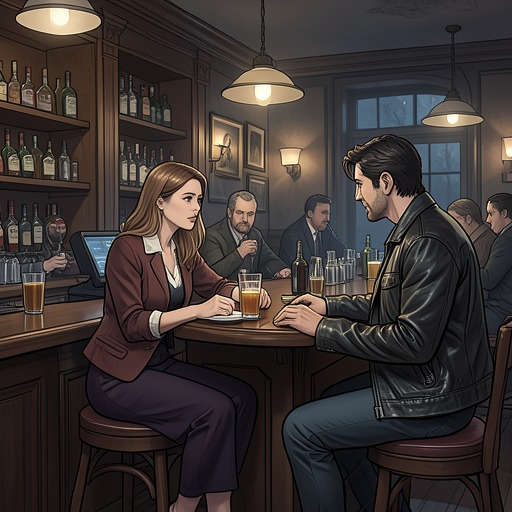
Sylvaine Abelan, Kingsley, and Brigitta
The Ballad of the Last DragonSylvaine Abelan, Kingsley, and Brigitta share a found-family bond formed through material care, everyday hospitality, and the recognition of Sylvaine’s worth as more than a displaced, hungry performer. The Rusty Nail becomes the first secure threshold in her adult life: a place where Kingsley gives her a chance to sing, Brigitta feeds her, and both quietly make room for her. Their kindness does not erase Sylvaine’s need for independence, but it gives her a durable image of home that continues to pull at her even after adventure, purpose, and love have carried her elsewhere.
Origins in Flight
Sylvaine’s connection with Kingsley and Brigitta begins after she flees Birchfield under desperate circumstances. At the Red Wyvern Tavern, its sleazy owner attempts to bribe her into exchanging sex for food after finding her scraping half-eaten food from dirty plates. Sylvaine leaves without a plan, carrying only her lute, the few coins earned from her performance, and her cap pulled down over her ears. When she reaches Hollowden days later, she can barely stand. Her arrival at The Rusty Nail therefore occurs not as a traveler choosing among comfortable inns, but as a person exhausted by poverty, exploitation, and sudden displacement.
Kingsley responds by allowing her to sing, giving her a way to earn a place through her art rather than treating her hunger as evidence of worthlessness. Brigitta, whom Sylvaine initially understands only as a woman associated with the tavern before realizing that she is Kingsley’s wife, asks Sylvaine to sample several dishes for the Winter Solstice celebration. The gesture supplies food, but its significance is larger: Sylvaine is invited into a communal preparation rather than left to survive on scraps. She later recognizes that Kingsley and Brigitta had been looking out for her, even when their care was expressed through ordinary tavern work rather than declarations of affection.
The Rusty Nail as Home
The tavern becomes a domestic refuge through repeated, unglamorous details. Sylvaine remembers the narrow cot in the corner of the small room that Kingsley and Brigitta prepared for her, as well as the package Kingsley sent with her when she first departed on her journey. These objects and arrangements give their care a physical form. The relationship is not abstract charity; it is a room made ready, supplies packed for departure, food offered at a festival, and work made available when Sylvaine has nowhere else to turn.
Sylvaine’s memories also retain the tavern’s imperfections. She misses the bad ale and wine they served and the nights spent badgering Kingsley with grand ideas while waiting for Petey to wake and go home. The affection is consequently grounded in shared routine rather than an idealized sanctuary. The Rusty Nail is shabby, noisy, and connected to a life Sylvaine once regarded as too small, but its very defects become part of the texture of belonging. Kingsley is not merely the barkeep who gave her employment; he is associated with a recognizable household in which Sylvaine had a place.
A later encounter with another barkeep makes that attachment physically immediate. When the man wipes the wooden surface between them with a cloth and throws it back over his shoulder, the familiar action resembles Kingsley so closely that Sylvaine’s stomach lurches. The involuntary reaction shows how deeply Kingsley’s presence has been inscribed in her memory. A simple professional gesture becomes a trigger for homesickness, linking the body of a stranger to the remembered safety of The Rusty Nail.
Care Without Possession
The bond does not depend on Sylvaine remaining permanently in Hollowden. She knows that she has always needed more than the town and more than a life sustained by charity, and she does not interpret departure as betrayal. On the road she finds purpose, adventure, and people who care for her through mutual understanding rather than pity. This contrast clarifies what Kingsley and Brigitta gave her at the beginning: their support helped her survive long enough to claim a life in which she could be valued for companionship, talent, and agency.
The distinction between charity and mutual care remains emotionally complicated. Sylvaine is grateful for the tavern, yet she also resists the idea that it should define the limits of her future. Her affection therefore contains both attachment and separation. The Rusty Nail is the home that receives her when she is nearly unable to stand, while the road becomes the chosen life in which she pursues Aeron Fowler’s quest and her own artistic ambitions. Kingsley and Brigitta protect her without possessing her; their importance lies partly in making departure possible.
That care is also tested by the hostility Sylvaine encounters elsewhere. In a tavern, a patron yanks her by the shoulder and calls her a “knife-ear,” insisting that she should be grateful to have been allowed inside and ordering her to fetch drinks. Her body responds with the onset of panic: her throat tightens, her chest turns cold, her legs go numb, and her head spins. The scene shows the social danger attached to her identity as an elf and the vulnerability intensified by her gender and precarious economic history. Against this world of conditional tolerance and open menace, the welcome Kingsley and Brigitta offered acquires the force of an alternative social order.
Distance, Longing, and Return
As Sylvaine’s expedition advances, her relationship with Kingsley and Brigitta persists as an obligation of affection. She expects that, once the adventure is complete, she will have to return to Hollowden at least to say farewell. The promise matters because she suspects Kingsley may have understood that she was destined for fame and glory, even when those ambitions once seemed so important to her. Her projected return is not a retreat into dependence; it is an acknowledgment that the people who sheltered her remain part of the story she is making.
Yet the prospect of return exposes a tension in Sylvaine’s ambitions. She imagines becoming the bard who writes the epic of a great hero, gaining entry to concert halls, singing in any tavern, and receiving the respected title she has always believed she deserved. Those achievements should fulfill the hunger that drove her away from Hollowden, but the thought of fame feels hollow. Her longing for the cot, the poor drink, the arguments with Kingsley, and the household formed with Brigitta suggests that public recognition cannot replace private belonging.
The relationship thus survives through a paradox. Sylvaine needs to leave the place that first saved her in order to become fully herself, but becoming herself teaches her how much that place mattered. She can love The Rusty Nail without wanting to remain confined by it, and she can pursue glory without allowing glory to become the sole measure of a meaningful life. Kingsley and Brigitta represent the home to which she may return, even as the road teaches her that home can also be carried as memory and obligation.
Narrative and Thematic Significance
The bond gives Sylvaine’s quest a personal history beneath its public ambitions. She is not simply a bard seeking access to prestigious halls or a companion spreading Aeron Fowler’s deeds; she is also someone whose first chance to continue living was created by tavern keepers who recognized her humanity when others saw only a hungry elf. The relationship makes her later self-confidence legible as development rather than innate triumph. Her wit, artistry, and defiance grow from a foundation of care.
Kingsley and Brigitta also embody a counterpoint to the anti-elf order Sylvaine describes. Human and dwarven histories have cast elves as beings of power and malice, while raids destroyed elven texts and sacred structures; in the present, that inherited fear still appears in insults, threats, and the expectation that elves should accept humiliation for access to ordinary spaces. The Rusty Nail’s welcome does not undo that history, but it demonstrates how hospitality can interrupt it at the scale of daily life. A meal, a performance, a prepared bed, and a travel package become acts of recognition against a culture that repeatedly denies Sylvaine’s belonging.
The relationship’s decisive meaning lies in its refusal to reduce home to either dependence or confinement. Kingsley and Brigitta’s household gives Sylvaine shelter without extinguishing her ambition, and Sylvaine’s departure does not cancel her gratitude. Her homesickness, her promised farewell, and the hollowness she feels before imagined fame all confirm that the bond remains active beyond physical distance. The family they form is therefore not a sentimental pause before the real adventure; it is the emotional ground from which Sylvaine enters the world and the measure against which that world’s rewards are judged.